If you’ve Googled “how much does a website cost” recently, you already know the answer is infuriatingly vague. One agency quotes $800. Another quotes $12,000. A freelancer on Fiverr says $150. They’re all technically “websites” — but they’re not the same product at all.
This guide breaks down exactly what you get at each price point, what drives costs up or down, the red flags to watch in proposals, and how to decide what your business actually needs. No filler, no bait-and-switch — just the honest breakdown.
Why Website Prices Vary So Much
The single biggest reason quotes vary wildly: most clients don’t know what to compare. A $900 website from a template shop and a $9,000 website from a strategy-led agency are solving completely different problems. One gives you a digital business card. The other builds a lead generation machine.
It’s: “What should this website do for my business, and what will it cost to build something that actually does it?” A website that generates 10 leads per month at $4,000 is a better investment than one that generates 0 leads at $800.
Four main variables drive price:
- Complexity — number of pages, custom features, integrations
- Design quality — template vs. custom vs. fully bespoke
- Strategy involvement — does anyone think about conversion, SEO, and messaging?
- Who builds it — DIY tools, offshore freelancers, local freelancers, boutique agencies, full-service agencies
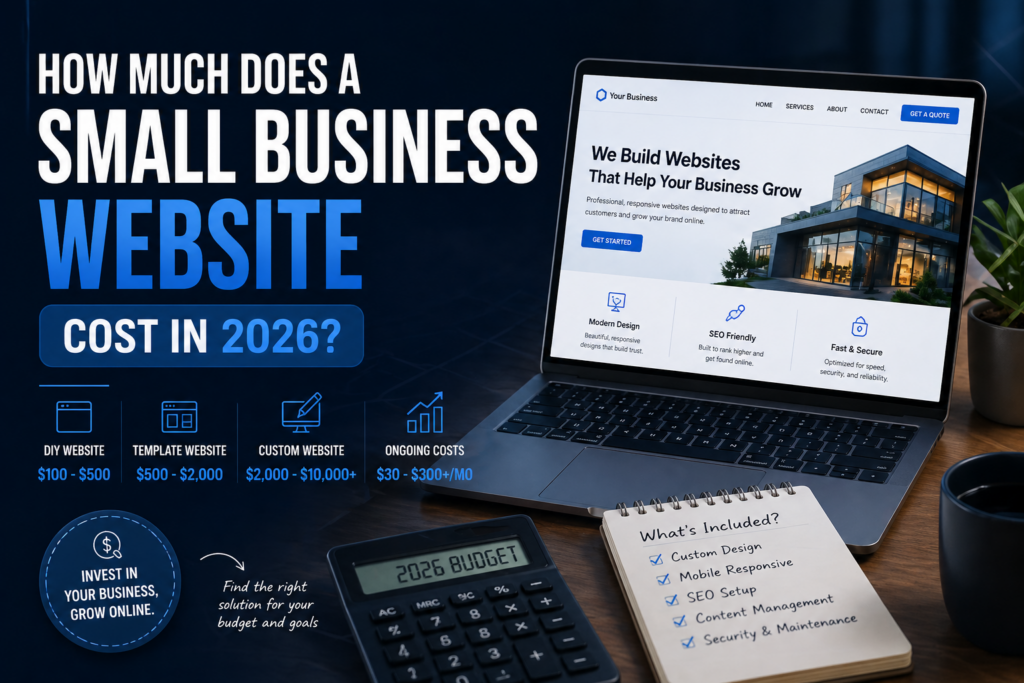
The 4 Tiers: What You Actually Get
What Drives the Cost Up
Within each tier, specific requirements push the price higher. Here’s what agencies are actually billing for:
1. Number of Pages and Content
A 5-page brochure site (Home, About, Services, Blog, Contact) is a very different scope than a 20-page site with individual service and location pages. Each page requires design, copy, and SEO work. Some agencies price per page; others bundle it. Ask how many pages are included before you compare quotes.
2. Custom Functionality
Contact forms are free. Booking systems, customer portals, quote calculators, live chat integrations, inventory feeds — those cost money. If you need something built (not just a plugin plugged in), budget for development time.
3. Copywriting
Most agencies quote design-only and assume you’ll provide the words. If you want them to write the copy — headlines, service descriptions, calls to action — that’s typically $150–$400 per page extra. It’s almost always worth it. Bad copy kills good design.
Paying for a beautiful design and writing their own copy. Your visitors don’t buy your design — they buy your words. If the headline doesn’t immediately answer “what do you do, for who, and why should I trust you?” — the design doesn’t matter.
4. SEO Foundation vs. Ongoing SEO
A properly built site includes on-page SEO: title tags, meta descriptions, heading structure, schema markup, image alt text, internal linking, and Google Search Console setup. That’s the foundation. Ongoing SEO (ranking for competitive keywords month after month) is a separate retainer — typically $500–$2,000/mo. Don’t confuse the two when reading proposals.
5. Hosting, Maintenance, and Updates
Many agencies charge a monthly hosting and maintenance fee ($50–$250/mo) after launch to keep the site fast, secure, and updated. This is often worth it — a hacked or broken site costs far more to fix than the monthly fee. Make sure proposals separate the one-time build cost from ongoing fees.
What You Should Expect at Each Price Point
Under $1,500 — Be Honest With Yourself
You can get a functional website for under $1,500. What you will not get: a custom design, strategic messaging, conversion optimization, or meaningful SEO. If your business lives or dies on your website (most do), this is underspending. If you’re a brand-new business validating an idea before investing, a budget site can work short-term.
$3,000–$6,000 — The Sweet Spot for Most Small Businesses
At this range, a good boutique agency can give you: a custom design built around your brand, a conversion-focused layout, properly written service pages, on-page SEO baked in, fast load times, and a mobile experience that doesn’t embarrass you. This is where most established small businesses should be investing.
$7,000–$15,000 — Competitive Markets and Multi-Service Businesses
If you’re in a competitive local market, have multiple service lines, need location-specific pages, or want to rank for more than a handful of keywords — this range gives you the depth to do it. More pages, more copy, more strategic thinking, better results over time.
Red Flags to Watch in Proposals
The ROI Framework: What Should a Website Return?
Here’s the question that cuts through all the noise: what is a new customer worth to your business?
If you’re a plumber and an average job is $400, and a customer calls you twice a year, that’s $800/year per customer. If a $5,000 website generates 2 new customers per month — that’s $19,200 in revenue over the first year. The website paid for itself in month 4.
Average job value × average jobs per year × average years a customer stays = lifetime value. Most service businesses are surprised how high this number is.
A well-built site in a medium-competition market should generate 15–40 inquiries per month once ranked. Even converting 20% of those is 3–8 new customers monthly.
If your customer LTV is $2,000 and you need 3 new customers/month to justify the investment — the website budget math becomes simple. You’re not spending $6,000. You’re buying $6,000/month in recurring revenue.
A new site typically takes 3–6 months to build meaningful organic traffic. Budget for that ramp-up period. The ROI on a well-built site is almost always there — it just takes patience and the right SEO foundation to unlock it.
The cheapest website isn’t the cheapest decision. A site that generates no leads costs you every month in lost revenue. A site that generates 5 leads/month pays for its build cost in weeks, not years. Invest in what works — not just what’s cheap.
Frequently Asked Questions
The Bottom Line
Here’s the short version: most small businesses in competitive service industries should invest $3,500–$7,000 in a well-built website with proper SEO foundations, professional copy, and a conversion-optimized design. That investment should pay for itself within 3–6 months if the site is built correctly and supported by even basic SEO or Google Ads.
Don’t anchor to the cheapest quote. Anchor to the outcome: a website that generates calls, form fills, and revenue — consistently, every month.
We audit small business websites every week. In 15 minutes, we can tell you exactly why your site isn’t generating leads — and what it would take to fix it. No sales pitch, no obligation. Just a straight answer.